
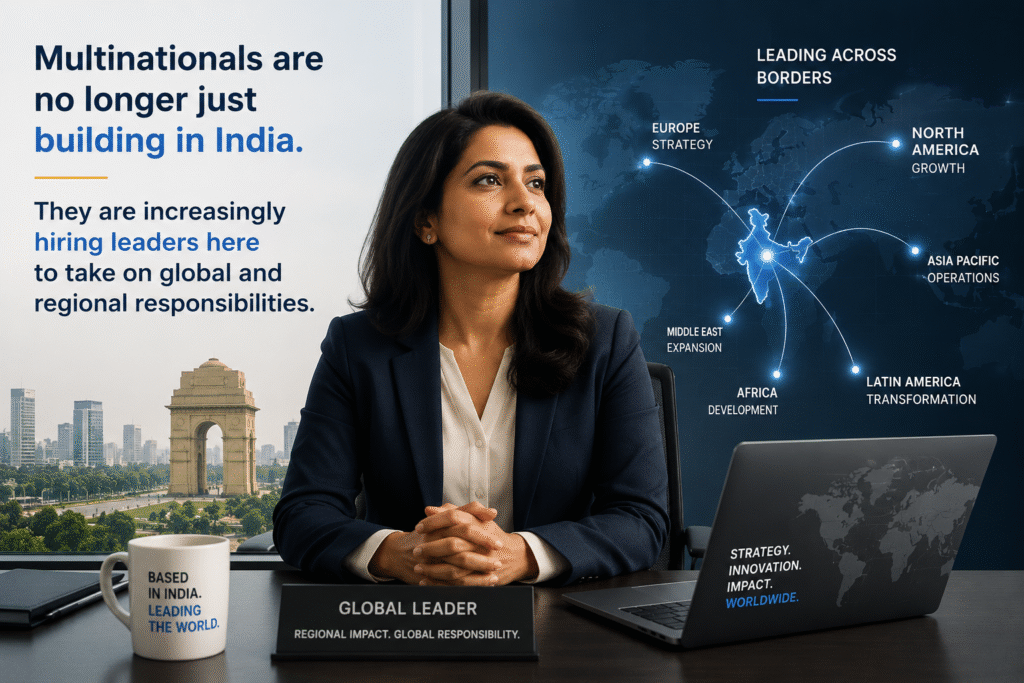
Multinationals are no longer just building in India. They are increasingly hiring leaders here to take on global and regional responsibilities. What this shift means — for organisations, for talent, and for the firms helping place them.
For three decades, India’s relationship with the global economy followed a familiar script. Multinational companies arrived, set up offshore operations, and filled them with talented Indian professionals who executed — efficiently, reliably, and at scale — on strategies designed elsewhere. India was the engine room. The bridge. The back office. The script was not disrespectful; it was simply the reality of how global business worked, and India played its part extraordinarily well.
That script is being rewritten. And the pace of the rewrite in 2025 and 2026 has been remarkable.
Vanguard, the US mutual fund giant, inaugurated its Global Capability Centre in Hyderabad and placed Venkatesh Natarajan — a leader who spent nearly three decades in the US, with tenures at Walmart, Lowe’s, and Qurate Retail — at the helm. Lowe’s appointed Ankur Mittal as Chief Technology Officer and Managing Director of its India operations. Danish shipping giant A.P. Moller-Maersk named Navneet Kapoor as Executive Vice President and Chief Technology Officer. These are not country manager appointments. These are global leadership mandates — held by leaders based in India, accountable to global boards, and driving enterprise-wide outcomes from Bengaluru and Hyderabad.
The data confirms what these individual appointments signal. According to GCC consultancy ANSR, leadership roles in Bengaluru more than doubled — from 21 in 2024 to 44 in 2025. In Hyderabad, the jump was even sharper: from 8 leadership roles to 42 in the same period. Across India’s GCC ecosystem — which now spans over 1,760 centres, employs 1.9 million professionals, and generates $64.6 billion in annual revenue — a structural shift is underway. This is not a trend. It is a reclassification of what India means to global business.
From Cost Centre to Command Centre
The evolution of GCCs in India has not been linear. The earliest generation of captive centres — established in the 1990s and early 2000s — were unambiguously cost-driven. Companies moved finance, IT support, and back-office processing to India to access a highly educated, English-speaking workforce at a fraction of the cost of their home markets. The value proposition was arbitrage, not strategy.
The second generation — roughly 2010 to 2020 — saw GCCs take on more complex work. Engineering centres began co-developing products rather than just maintaining them. Analytics teams began influencing business decisions rather than just reporting data. The centres grew in sophistication, but the fundamental dynamic remained: strategy flowed from headquarters, and India executed.
What is happening now is categorically different. Today’s GCCs are co-owning outcomes — not just delivering against instructions. As Naveen Gattu of GCC consultancy Straive put it, the shift is “less about delegation and more about shared accountability.” Global product roadmaps are being designed in Bengaluru. AI infrastructure is being built in Hyderabad. Risk frameworks for global banking operations are being developed in Chennai. And the leaders driving those outcomes are based in India, not visiting it.
This shift is especially visible in technology, BFSI, and product engineering, where India-based leaders are now running global transformation programmes, managing P&L for international business units, and owning intellectual property that sits at the core of the parent company’s competitive advantage. The back office has become the brain.
Why Indian Leaders Are Ready — and Why the Market Is Finally Acknowledging It
The elevation of Indian leaders to global roles is not a concession made under talent scarcity. It is a recognition of genuine capability — capability that has been building quietly for two decades and has now reached a critical mass that global boards can no longer overlook.
India-based leaders bring a combination of qualities that is increasingly rare and increasingly valuable. They have managed at scale — often leading teams of hundreds or thousands across multiple geographies and time zones. They are deeply comfortable with ambiguity, having built careers in environments where structures, processes, and priorities shift rapidly. They possess what might be called structural cultural agility: the ability to understand, communicate with, and earn the trust of stakeholders from vastly different backgrounds, whether that means a CTO in San Francisco, a CFO in Amsterdam, or a delivery team in Manila.
Crucially, the best Indian leaders operating in GCC environments have also developed something that cannot be taught in business school: the ability to balance global standards with local execution. They understand what headquarters needs to see, and they understand what a team in India needs to hear. That bridge-building capacity — operating credibly at both ends of a global organisation simultaneously — is exactly what MNCs need as they move from managing India as a geography to leveraging it as a strategic asset.
There is also, frankly, a generational factor at play. A cohort of Indian professionals who began their careers in the late 1990s and 2000s — who grew up inside GCCs, who earned their scars navigating the financial crisis, the digital transformation wave, and the pandemic — are now in their forties and early fifties. They are the right age, the right experience level, and the right mindset for the roles that global companies are now seeking to fill from India.
The New Leadership Profile: What MNCs Are Actually Searching For
Understanding that MNCs want to hire leaders from India is one thing. Understanding precisely what kind of leader they are searching for is another — and the distinction matters enormously for both organisations conducting searches and professionals positioning themselves for these roles.
The titles being created in 2026 give the clearest signal: Chief Technology Officer, Global Head of AI, VP of Product for the entire enterprise, Global Head of Engineering, Chief Data Officer. These are not India-market roles with a global prefix added for prestige. They are genuine enterprise mandates, with direct accountability to global boards, multi-country teams, and business outcomes that affect the parent company’s competitive position worldwide.
The leadership profile these roles demand has several non-negotiable dimensions. AI fluency is now baseline — not optional. Leaders who cannot speak with authority about how artificial intelligence is reshaping their function are not competitive for global mandates, regardless of their other credentials. Cross-functional ownership is essential — the ability to collaborate with, influence, and sometimes override peers across engineering, finance, product, and operations without formal authority. And perhaps most critically, the ability to manage HQ relationships with sophistication — to earn the trust of a board that is thousands of miles away, to communicate setbacks without losing credibility, and to translate India’s reality into a language that resonates in boardrooms in New York, London, or Copenhagen.
There is also growing demand for what might be called “set-up” leaders — executives who have experience building organisations from the ground up, not just running mature ones. Setting up a GCC and scaling it are fundamentally different challenges. Most leaders have deep experience in one or the other. The rarest and most sought-after profiles are those who have done both.
The Hiring Challenge Hiding Behind the Opportunity
The opportunity is real. The challenge of accessing it is equally real, and organisations that underestimate the difficulty of these searches tend to pay for that miscalculation in time, money, and organisational disruption.
The candidate pool for genuine global leadership roles based in India is small and almost entirely passive. Senior GCC leaders are not browsing job boards. They are not responding to InMail from recruiters they do not know. They are busy, well-compensated, and typically engaged in work that matters to them. Reaching them requires relationships, discretion, and credibility — the kind that comes from years of operating in the same ecosystem, not from a database query.
Compensation complexity is another underappreciated challenge. The Indian leadership talent market has repriced significantly. Senior GCC leaders in 2026 command fixed compensation well above what the market expected even three years ago, alongside meaningful equity in the parent company — RSUs, ESOPs, and stock options linked to global performance. Navigating these structures, benchmarking them correctly, and structuring offers that a high-value candidate will actually accept requires specialist knowledge that most internal HR teams and generalist recruiters simply do not have.
And then there is the cost of getting it wrong. A mis-hire at the VP or CXO level in a GCC does not just slow things down. It erodes HQ confidence in the India operation, disrupts teams that were built around the wrong leader, and can set back an organisation’s India ambitions by years. Getting these decisions right the first time is not a luxury. It is a business imperative.
Where i4 Fits In
This is precisely the space where i4 operates.
i4 is a specialist leadership hiring and advisory firm built for this new era of global leadership from India. We work with multinational organisations — particularly those building, scaling, or transforming their GCC presence — to identify, assess, and place the leaders who can carry genuine global mandates. Our work is not transactional executive search. It is a rigorous, relationship-driven process that starts with understanding the organisation’s strategic intent and ends only when the right leader is in the right seat.
Our leadership hiring practice focuses on the roles that matter most: CXO and VP-level appointments with global or regional scope, functional leadership in technology, product, engineering, AI, and operations, and the increasingly critical category of GCC set-up leaders — the rare executives who can build an organisation, not just run one. We bring deep networks within India’s senior leadership ecosystem, the market intelligence to benchmark roles and compensation accurately, and the assessment rigour to distinguish leaders who interview well from leaders who perform.
We also work on the other side of this equation. For senior Indian professionals who are ready for a global mandate — whether they are currently based in India, returning from an international posting, or seeking to make the transition from a large enterprise to a high-growth GCC environment — i4 offers leadership advisory and career positioning support. We help exceptional leaders articulate their global readiness in the language that boards and search committees respond to, build the profile and narrative that positions them for the roles they are genuinely capable of, and navigate the career conversations that matter most.
The elevation of India-based leaders to global roles is not a moment. It is a movement. The organisations and professionals who recognise it early and position themselves for it deliberately will define the next chapter of Indian business leadership.
If you are a multinational organisation looking to hire for a global leadership role based in India, or a senior professional ready to step into a broader mandate, i4 would welcome the conversation. Reach out to us at i4 Consulting.