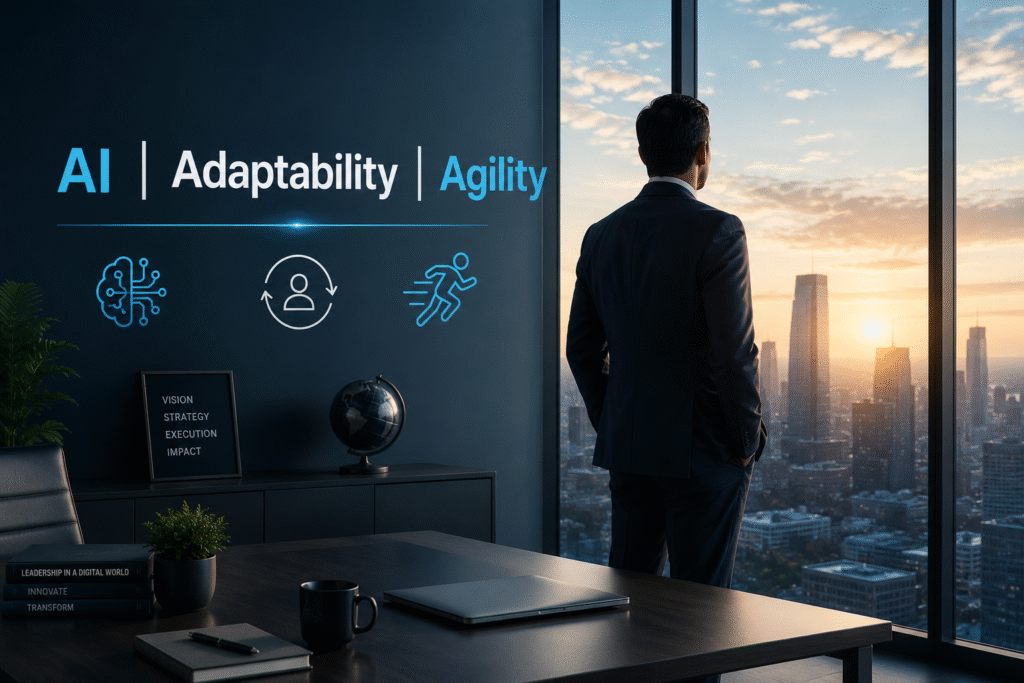
For most of the last two decades, leadership hiring followed a familiar script. Boards and CEOs looked for domain expertise, a track record of revenue growth, and the kind of institutional pedigree — the right MBA, the right employer brands — that signalled credibility. Those things still matter. But they are no longer enough. The leaders being hired today, and the ones being passed over, are being evaluated on an entirely different set of criteria.
The shift has been accelerating for a few years, but 2025 and 2026 have made it impossible to ignore. AI is restructuring every function inside every organisation simultaneously. Markets are moving faster than annual planning cycles can accommodate. And the half-life of any specific strategy is shrinking. In this environment, what separates an exceptional leader from a merely competent one is not what they know — it is how quickly they learn, how decisively they act on incomplete information, and how effectively they bring others with them through continuous change.
AI Fluency Is Now a Leadership Expectation
Boards are no longer satisfied with leaders who delegate AI strategy to a Chief AI Officer and move on. The expectation in 2026 is that every C-suite leader — whether they run finance, operations, HR, or product — understands how AI is reshaping their function, can make informed investment decisions around AI adoption, and can ask the right questions of the teams implementing it. This does not mean writing code. It means possessing enough conceptual fluency to distinguish genuine transformation from expensive experimentation, and enough courage to make big bets when the evidence justifies them.
Search firms and executive assessment panels are now explicitly testing for this. Candidates who cannot articulate how AI has changed their function in the last 18 months, or who have no view on where it is heading, are increasingly being screened out at the brief stage — regardless of their other credentials.
Agility Over Tenure
The premium on long tenures and deep single-industry expertise is fading. What is replacing it is a demand for leaders who have navigated genuine discontinuity — who have run a business through a pivot, rebuilt a team after a restructuring, or entered an unfamiliar market and delivered results. Organisations hiring in 2026 are not just buying a leader’s past. They are buying their capacity to perform in futures that have not been written yet. Demonstrated agility — the ability to move fast, make decisions with ambiguity, and course-correct without ego — has become one of the most valued signals in leadership assessment.
Adaptability as Character, Not Just Skill
Adaptability has always appeared on leadership competency frameworks. What has changed is how seriously it is being assessed. In the past, it was a soft criterion — a tie-breaker at best. Today it is a first-order filter. The leaders who are thriving are those who treat disruption as a design condition rather than an exception. They build organisations that absorb change rather than resist it. They model intellectual curiosity publicly, change their minds when the data demands it, and create cultures where learning is valued over the appearance of certainty.
Identifying this quality reliably requires more sophisticated assessment than a competency interview. The best executive search processes today include structured scenario-based evaluation, psychometric tools validated for leadership contexts, and deep referencing that specifically probes how a candidate has responded to setbacks and surprises — not just successes.
The leaders who will define the next decade are not the ones with the most polished CVs. They are the ones who have learned to be genuinely comfortable with uncertainty — and who can make an organisation feel the same way.
At i4, our leadership hiring practice is built around exactly these criteria. We help organisations identify and assess leaders who are not just experienced — but genuinely equipped for what is coming next. If you are building a leadership team for the AI era, or if you are a senior professional looking to position yourself for the roles that matter most in 2026, we would like to talk.